When I turned 17, I bought my first car, a used ’84 Chevy Cavalier coupe, from my dad’s friend in Denver. The wanna-be sporty two-door had a stick though, and when we picked it up, my dad handed me the keys. Never mind the fact that it was my first time driving a manual transmission, my dad believed in trial by fire, and off we went. It would’ve been one thing to get the lurch-and-stall hang of driving stick in that suburban neighborhood of eastern Aurora, and have my dad take over for the errand in downtown Denver he had planned, but he just encouraged me on there myself.
Headed south on Broadway Ave., I was a nervous wreck, and it didn’t seem to be going well. I silently prayed for green lights to miraculously guide me back to the interstate but instead we seemed to be hitting every other one red. When I stalled hard as the lead car at a left green arrow, and heard a barrage of horns behind me as I struggled to restart and drop the clutch, a second, and then third time, I almost cried.
Twenty years later, I had the chance to return the favor to my father, David. We’d been climbing Colorado 14’ers together for many years, and had already navigated some of the more difficult standard routes together, like Pyramid and Capitol peaks, which were more fun than unnerving for us, and he had mentioned wanting bigger challenges. He also had recently discovered the excitement of serious mountaineering through books and magazines. So I decided to surprise him for his birthday with a guided springtime mountaineering assent on Long’s Peak, up a classic snow to 5th class rock route called Kiener’s Route.
He was thrilled with the idea, but having never even had crampons on his boots before, I knew there was some training that had to be done first. In January we headed down to a shadowy hole in the San Juan Mountains at the town of Ouray for some ice climbing action in their incredible box canyon. Here, at their abundance of farmed cascading ice falls, I was able to teach him the basics of how to walk, climb, and even fall with large steel spikes on his feet while attached to a rope. As a contractor, he knew how to swing a hammer well, and wasn’t afraid of heights, but when I top-rope lowered him into the 100’ deep gaping canyon, his eyes got as big as I’d ever seen as he leaned back over the edge. Despite a few dinner plate-like ice chunks that came off his ice axes toward him as he climbed back up, he had a blast and was thrilled at his upcoming adventure.
On the way back home, he convinced me that he would have much more fun on Long’s Peak if I joined the party. We talked about doing it unguided, but as I was unfamiliar with the route, having never climbed it myself, and him being a novice, we knew that it would be best to have an experienced guide lead the way. On longer alpine climbs on 14,000-foot peaks, route finding can be a serious challenge, and the danger of injury or worse is real. I had guide friends who worked at Colorado Mountain Guides in Estes Park, and knew they were a solid choice. The trip was booked and that May we were ready for action.
We arrived in sleepy Estes Park the afternoon before, met with our guide (my friends were guiding elsewhere) and picked up a last few things. We car camped in their parking lot and had an early alarm at 3:30 AM. We were at the trailhead an hour later, packed and ready to start hiking. Ahead of us was 14 miles, 5,100 vertical feet of gain, and full day of adventure.
While it was just a single day mission, our packs were not light. We had enough food and water to be out for 10 hours, plus clothing layer options for a wide range of temperatures and conditions. Then there was the gear: mountaineering boots, crampons, piolet (a longer ice ax for mountaineering), harness, helmet, and technical rigging gear. Our guide, Rob, was a cool, experienced and strong fellow, but not too proud to not let us help shoulder our share of the gear we would all be using to protect ourselves from the dangers of a fall, like ice screws, rock anchor gear, and a long rope.
Headlamps on, we hiked up the frozen dirt trail in the otherwise pitch-black remnant of the night. Even brimming with excitement, leaving the car seems to always be tough. You are headed into the frozen chill of the morning, and soon enough will start to warm from the upward slogging, so unless you plan to stop often to shed layers, you need to start cold, which I’ve never gotten used to. But the first legs of these kinds of adventures seem to fly by for me, with lots of talking and excitement, and fresh legs. And so we found ourselves cresting above tree line at the same time the sun crested below us on the eastern Colorado plains.
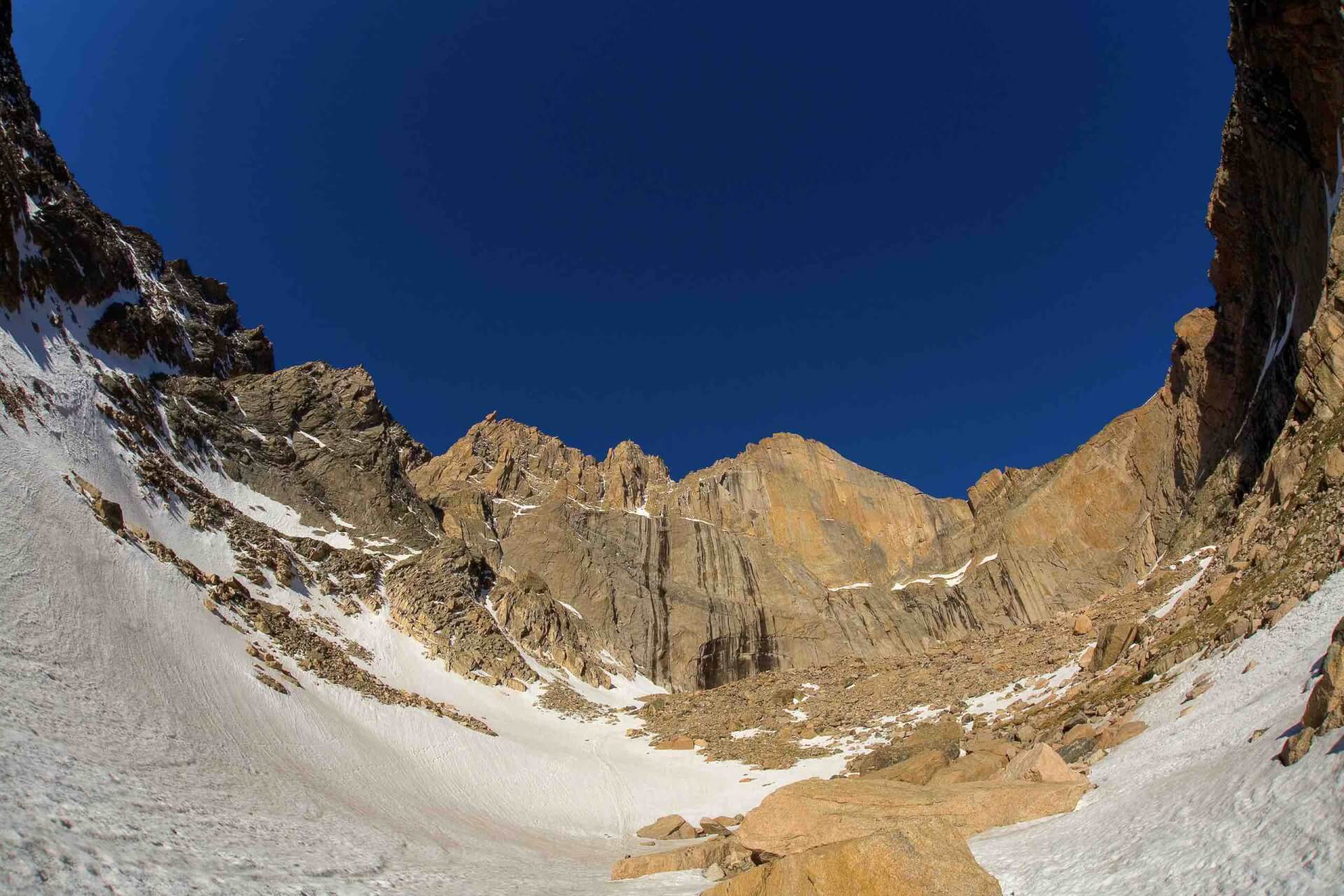
The sunrise was gorgeous, and ahead of us, bathed in the pink and orange light of dawn, stood the 1,000’ vertical behemoth face of The Diamond on Longs Peak. This stunning alpine wall is famous with elite rock climbers worldwide, harboring difficult rock climb test-pieces at high elevation. To stand at its base is to experience a powerful piece of Colorado’s best. We were about to climb up around the side of it.
The first recorded ascent of Longs Peak, the northernmost “fourteener” in the Rocky Mountains, was in August 23, 1868 by the surveying party of John Wesley Powell. The standard hiking route, to the north of The Diamond face, (named for the resemblance to the shape), is non-technical during the summertime, but it is still a long arduous hike at high elevation.
But we weren’t here for the easy way up. So we headed up one of only fifty or so small mountain glaciers in Colorado toward the base of the wall, stopping at Mills Glacier, above the then frozen Chasm Lake. We found ourselves in the middle of a surreal and beautiful mountain amphitheater, the looming wall behind us, mountain spires all around, and the glacier valley that spills out onto the Front Range. Here, we donned harnesses, crampons, axes and rope. To our left stood a steep shadowy ice and snow ramp, plenty wide, and 800’ tall.
Roped closely together, we began side step chopping our crampons into the high-angle frozen snow face, moving diagonally up one way, and then switching directions repeatedly. Stopping halfway up to catch our breath, it became very easy to see why it’s called the Lamb’s Slide, named after Reverend Elkanah Lamb’s unintentional slide down much of the route in 1871. The zigzag side-stepping made our feet ache, but this was no place to hang out, as the vertical wall above us occasionally sent an errant rock down onto the slide, as the freeze thaw cycle works without rest and is constantly dislodging new rocks in grenade-like fashion.
At the top of the ramp, we exited onto the wall and moved onto a ledge system that traverses horizontally nearly 1,000’ back over the ramp we had climbed, and directly toward The Diamond face. This famous ledge, called Broadway, is wide enough in some spots to lie down and enjoy the sun. But in other places, it narrows to a thin strip of rock and snow, or exposed grass, which demands attention and respect.
As we moved further along above the ramp, the exposure below us grew. Broadway undulates across the contour of the face as you head toward The Diamond. At times that meant crossing the side of a steep snow slope, and at others it required us to use our hands to steady ourselves on the rocks over the narrow ledge under our crampons. All the while, we were roped safely to our guide, and each other, and would take turns in succession crossing dangerous places, so that a fall would be protected with rock anchors.
Like myself in that Chevy Cavalier, having to perform under pressure with something new, my dad now had his turn to navigate down Broadway. His first experience of moving steadily in such an unforgiving place came with the added stress of doing it with an 800’ vertical drop below him. At it’s toughest spot, or crux, it requires one to cross around and sort of underneath a boulder that juts over the ledge. The move is to use your hands to hug the boulder while your feet are further back underneath you. When my dad had to lean back on his arms, I could see on his face that he was fully aware of the massive drop below him. It reminded me of that left turn arrow I had to make years before. However, once he got around it, he was all smiles.
Broadway dead-ends into The Diamond, but before that we exited left up a prominent gulley that continues up to a summit ridge, called The Notch, which is a separate route that splits here. Instead, we went more climbers right up a short snow ramp and into a rock corner. Here above us was the crux of the whole route, a granite chock stone that requires easy 5.4 graded rock climbing to ascend. The gap between the chock stone and corner was wet with snowmelt and just wider than a boot but there were ample holds up the 20’ section. Rock climbing with crampons, however is a unique experience. While my dad had been climbing before, this was another first for him, and one in which he was unsure of himself.
I dropped the proverbial keys in his hand, and told him to get driving. It may have looked a bit lurch and stall, but he got up it. The next several hundred feet of vertical were steep blocky ramps, linked by snow and dirt patches. We stayed on belay, as this was technically fun low-angle slab climbing, and with the huge air off the cliffs below us, it felt like climbing in space. By now the sun was high in the sky, and we stopped to enjoy lunch on a relaxing flat ledge. We talked of how it was fun to be in such a uniquely Colorado spot. The warming spring air and gorgeous view gave us a sense of safety in such a relatively exposed position. It’s one not to be taken lightly, as prevalent weather sends storms sneaking up from the other side of the mountain.
In January, 1925, Colorado Mountain Club members Walter Kiener and his friend, and legendary state outdoorswoman, Agnes W Vaille, set out on their third attempt to establish the first winter ascent up the east side of Longs Peak.
Kiener was certain he had found the easiest way up, and at around 4:00 AM on January, 10th, and twenty hours after they departed from the Timberline Cabin below, they made the summit in a winter storm, having climbed what’s now known as Kiener’s Route, but it also came at great cost.
We were still several hundred feet below the summit though and needed to keep moving. Done with the technical climbing portion, we began climbing the wide upper rock and snow ramp that follows along the upper slanted edge of The Diamond face. The sun was softening the spring snow and made it difficult to climb in, and at times we watched the slush actually flow down the still steep slope beside us. At the top of this section, the last of the route’s puzzle presents itself in a headwall that forces you to traverse back toward the edge of The Diamond’s sheer cliff face to pass by. It ends in a series of large stone steps, and an airy move around the corner at the top of the headwall. Though you never get close to the edge, with the full 1,800’ of drop just behind you, it’s a bit of a puckering moment. With only a lower angle rock scramble remaining to the top, we pushed through and completed the climb. We were both spent and ecstatic in the same moment.
But as it’s said, the summit is actually only the halfway point, and we were ready to head down. We decided the best decent would be down the keyhole route, or the regular summer hiking route. But with much snow still left on it, we got to enjoy some controlled glissading, or sliding, down several of the slopes, slowing ourselves by pushing our ice axes into the slope. We finally traversed around the backside of the mountain to the feature known as the keyhole, which is actually a striking rock arch at a prominent spot on the north side of the mountain. Below us was the boulder field, a massive area of broken rock that is tricky to walk on, and also a long way yet back to the truck.
Tragically, it was here, after their summit, that Ms. Vaille became exhausted on the decent, falling above the boulder field, still high on the mountain, and was unable to continue. Kiener set off to retrieve a rescue party, but upon reaching her, they learned they were too late to save her. Another member of the search party became lost and also perished.
Kiener himself suffered serious frostbite on his hands and feet and while he lost most of his toes and many fingers to the fateful climb, he later earned a PHD in botany and returned to guide hikes on the mountain, and did important work studying the alpine vegetation while living in a stone hut he built at the boulder field that was put on the National Historic Register in 1992 and still stands today.
There are signs at the hut that memorialize the events, and lend perspective to those who pass by, that this is a place that holds deep history for Coloradans. And as we set off, tired, sore, and incredibly happy, toward our vehicle below in the forest, we knew that any day in the mountains should be appreciated for the power the mountains hold, and grateful for our fun, success, and safety.